(2) In the Grade of SECRET MASTER the inspection of workmen on Mount Lebanon is entrusted to his care.
(3) In that of PERFECT MASTER he has the charge of erecting a suitable monument to the memory of the Master Builder.
(4) In certain secret workings which cannot be specified here he is seen acting as a kind of Intendant of the Building,
(5) he is otherwise represented as the lawful and elected successor of the great Son of the Widow: on him therefore devolved the completion of the sacred edifice.
Most of these stories exclude one another, and it is difficult at this day to speculate how or with whom they originated. ADONHIRAMITE MASONRY itself-as the name of a specific system arose in France. It has been referred to Baron Tschoudy and alternatively to Louis Guillemain de Saint-Victor. In either case evidence is wanting to determine whether the one or the other compiled the system or wrote only the accounts concerning it.
Contradictions and Confusions.. It is not less uncertain whether it emerged into the activity of a living Rite, or whether it remained on paper within the covers of the volume by which we are acquainted with its content. However this may be, it consisted of Twelve Grades, being
(I) ENTERED APPRENTICE,
(2) COMPANION,
(3) MASTER,
(4) FIRST ELECT,
(5) SECOND ELECT,
(6) THIRD ELECT,
(7) LITTLE ARCHITECT,
(8) GRAND ARCHITECT,
(9) SCOTTISH MASTER,
(IO) KNIGHT OF THE SWORD, otherwise KNIGHT OF THE EAST, or of the Eagle,
(II) KNIGHT ROSE-CROIX, and
(I2) NOACHITE, or PRUSSIAN KNIGHT.
Of these Grades, those which are superposed upon the Craft system are mostly familiar in other and also in earlier Rites, so that ADONHIRAMITE MASONRY added little to Masonic symbolism or knowledge, as variants in litturgies and ritual procedure do not belong to these categories. The contradictions and confusions which characterise the ELECT GRADES seem, if anything, to be brought out more clearly; there is no logical sequence, for there is nothing to fill the great spaces of time between the erection of Solomon's Temple and that of Zerubbabel, or between the epoch of Cyrus and of Christ.. The GRADE OF ROSECROIX in the series is a miserable vestige of a great mystical ceremony, and by such substitution we are introduced to the crown of the whole symbolical edifice, namely, PRUSSIAN KNIGHT, wherein we are transferred suddenly from the Christian Dispensation to that of Noah and Babel. It will be dealt with in the proper place; in this I am concerned only with exhibiting the supreme unreason of the Ritual procedure. It follows that ADONHIRAMITE MASONRY leads nowhere, as indeed its title indicates, the raison d'etre of which is an arbitrary substitution of the son of Abda in place of Hiram Abif, as King Solomon's Master-Architect. We know that there are insuperable difficulties in respect of the latter when the traditional story of Masonry is checked by Holy Scripture; but neither these nor any other consideration can excuse the chance. which confounds confusion further.
Other Adonhiram Grades.. I have intimated, however, that Adoniram is a person of the drama outside the late and formal system which passes under the name of Saint-Victor. In addition to the Grades which I have mentioned he is prominent in MARK MASONRY, in the Degrees of ROYAL MASTER and INTENDANT OF THE BUILDING. From the last it follows that the Adonhiramite motive in Masonry goes back to the COUNCIL OF EMPERORS OF THE EAST AND WEST. From the Grades of ROYAL and SELECT MASTER it follows-as we have seen that it enters also into CRYPTIC MASONRY, about the symbolical importance of which in connection with the HOLY ROYAL ARCH I hold strong views and on occasion have expressed them strongly. These are titles of honour, if I may venture so to express it, but none of them compares with the consequence attaching to the fact that Adoniram belongs also to the Honourable Degree of MARK MASTER MASON, not only in the Ceremony of Advancement but in the secret workings attached thereto. ADONHIRAMITE MASONRY' is therefore of great importance in High Grades connected with the Old Alliance, and this fact justifies a reasonable resentment against the unprovoked invasion of another field of symbolism by an attempt to take it into the Craft itself.
Origin of the Rite. The introduction of Adoniram into Symbolical Masonry of the King Solomon period can be accounted for in an obvious manner. We have seen that he was placed over the tribute, as chief receiver, and indeed held this position during the successive reigns of David, Solomon and Rehoboam, as we learn by 2 SAMUEL xx. 24; I KINGS iv. 6, and ib. xii. I8. He was stoned to death, while exercising the duties of his office, by the people-then in revolt. It follows that he was not the Master-Architect of King Solomon's Temple, as pretended by Adonhiramite Masonry-though he is connected with the work on the timber in the forest of Lebanon-and that he did not succeed Hiram-Abiff. These are Masonic inventions and legends. But he was a person of importance during a long period in Israel, and as such was recommended to the early makers of Rituals and the founders of mythical Masonic history. It happened unfortunately for the subject that these alumni worked independently of each other and produced mutually exclusive accounts, among which I have selected a few only. As regards that RITE which is officially La Ma‡onnerie Adonhiramite, we have to thank Saint-Victor for collecting and editing its Grades, which-also most probably-were never worked as such. At a later period he produced what purports to be an account of the origin of his invention, but it is the mere fashion of a title, dealing neither with ADONHIRAMITE nor HIRAMIC MASONRY, but with
(I) the philosophy of the Magi, regarded as a general name for the antique priesthood;
(2) the origin of the Instituted Mysteries as they were practised in Egypt and Greece;
(3) the sciences possessed by their hierophants; and
(4) the modes of reception into the Mystenes.
To Operative or Emblematic Freemasonry-as the terms are understood by us-there is no word of reference throughout.
Authorities. The authorities for this notice are
(I) Louis Guillemain de Saint-Victor: RECUEIL PRÉCIEUX DE LA MACONNERIE ADONHIRAMITE, contenant Les Catechismes des Trois premiers Grades, etc. 2 Vols. PhiladeIphia (Paris), 1785.
(2) The same: ORIGINE DE LA MACONNERIE ADONHIRAMITE, OU Nouvelles Observations . . . sur la Philosophie, les Hieroglyphes, les Mystéres . . . et les vices des Mages. A Heliopolis (Paris), I787.
(3) A. E. Waite: THE SECRET TRADITION IN FREEMASONRY'. 2 Vols., Iglr. Vol. I, pp. IS8, IS9, I63, I64, I66, I68, I69, I72, I74, 255, 256.
Adoptie
Mackey,
v (-s) zie MAçONN(ieke)ERIE
ADONIS AND HIS MYSTERIES
aenusian Mysteries.
Adonia and Eleusinia.
Authorities.
Mackay
There is neither space nor occasion to consider at length those Rites by which Greece commemorated the death and resurrection of Adonis. Their reflection from the cultus of Tammuz is also no part of our research, as it belongs to the antiquities of a subject with which we are concerned in respect only of its inward and deeper life. It should be understood, however, that the MYSTERIES OF ADONIS are comparatively speaking late-in contrast, for example, with those practised at Eleusis. They have been referred to the epoch of the Seleucides. We must set aside what is said of them on the part of Masonic writers, who have supposed fondly that they are in close " connection with the early history and reputed origin of Freemasonry," because in the Phaenician and Tammuz period they were celebrated at Byblos, otherwise the scriptural Gebal, inhabited by the Giblites or " stone-squarers " of Solomon's Temple. Hereof is the finding of A. G. Mackey, who discourses also on the secret promulgation of " the once hidden doctrine of a future life." But that which was hidden was the kind of life to come, as this was opened to the vision of the epopts; the matter of survival itself was in no sense reserved by the Keepers of the Mysteries to such as were brought within them, for Elysium and Tartarus were open dreams of doctrine. If, however, there was a time when the RITES OF ADONIS gave any message to their initiates, such as that which is connoted by Eleusis, the record is wanting concerning it; but it would appear more than doubtful. They were also RITES OF VENUS, and the myth of the pageant in all its versions is a servile copy of those belonging to Demeter-produced on a lower key. I do not propose to recite all the variants, but if we take the version of Bion -to which the others bear a root-likeness-Adonis was the favourite of Venus, on account of his beauty. When he was killed by a wild boar, and went down to the underworld, Proserpine became enamoured of him also and refused to restore him to earth, notwithstanding the prayers of Venus. An appeal followed to Jupiter, with the result that the youth's future was divided between them-six months in the bowers of earth and six in Tartarus. It will be seen that the purity of Eleusis is contaminated by the later pageant.
Venusian Mysteries.. I have indicated that the MYSTERIES OF ADONIS are those also of Venus, and although it seems possible that in Phoenicia and at Byblos there may have been a time when they were not apart from purity, that period had passed when they were inported by Greece. In the Phoenician story Adonis was the wife of Astarte and with the help of Ammon his father he had civilised Egypt. He travelled thereafter to Syria and was supposed to have been slain by a wild boar, while hunting on Mount Lebanon. Phaenicia, Egypt and Astarte combined to mourn him, but it had been decreed that he who was accounted dead should yet return to life, and there was joy among all the peoples. If this was the dramatic pageant presented in the MYSTERIES OF BYBLOS, they may well have been like those of Eleusis in their reticence and the concealments of their modesty: then either would reconstruct easily along spiritual lines, for those who wish to transmute them. But the records are doubtful, and I question whether this form of the mystery was not more especially on paper in the testimony of Phansutus, for Lucian-or whoever was the author of DE DEA SYRI’-gives another picture. In any case the ADONIA of Greece corrupted the ELEUSINIA in their reflection by filling the heart of Proserpine with desire for the beautiful youth whom an untimely chance had taken into the underworld. By shadowed shrines and in the half light of encircling groves there were enforced sacrifices of womanhood, on sale for the profit of the temple, not to speak of any host of courtesans trafficking on their own part in the grades of love.
Adonia and Eleusinia., Adonis was virile youth and glory of physical beauty, but the house of Venus was a brothel, and thus the Rites were stained, as if from flower to root: acacia maculata indeed, and all the feasts were orgies. If it is possible to set apart for a moment this mise en sc‚ne and dwell upon the so-called Resurrection of Adonis, it has nothing to communicate which cannot be received under different circumstances in the pageants of Eleusis. The return of Adonis from the underworld is but a poor copy of the annual rendering to earthly life of her who was Proserpine and Ceres. I know that both are but shadows and feeble substitutes of the mystical truth in experience which they are held to adumbrate: they are the back parts of the Divine Mysteries. There is in truth neither mystic death nor resurrection in the one or the other case. It was not given to mythologies to do more than distort in reflection the divine and eternal mythos which is exemplified once and for ever-as pattern and prototype to all the ages of sanctity in the Christ-story of Palestine. The adumbration and shadowing of the Master-Grade in Masonry is nearer than anything put forward by Egypt and Greece.
Authorities. It would serve no purpose to make a display of knowledge by citing classical authorities and commentaries on these. I have mentioned Bion's EPITAPH ON ADONIS, the work of Pharnutus and the tract attributed to Lucian, about the authorship of which there is grave doubt. The fifteenth idyll of Theocritus should also be remembered and Ovid's ART OF LOVE, Lib. I. The ADONIA are mentioned by St. Melito, St. Clement of Alexandria, St. Jerome, St. Cyril, and by Julius Firmicus Maternus, Ammianus Marcellinus and Procopius. A good general account of the ADONIAH will be found in Baron de Sainte-Croix: M‚MOIRES pour servir a I'Histoire de la Religion Secrete A des Anciens Peuples. Paris, I784; PP. 441-454. It may thought, however, that he exaggerated the corruption of the Mysteries by an insufficient distinction between their earlier and later forms
Adonis,
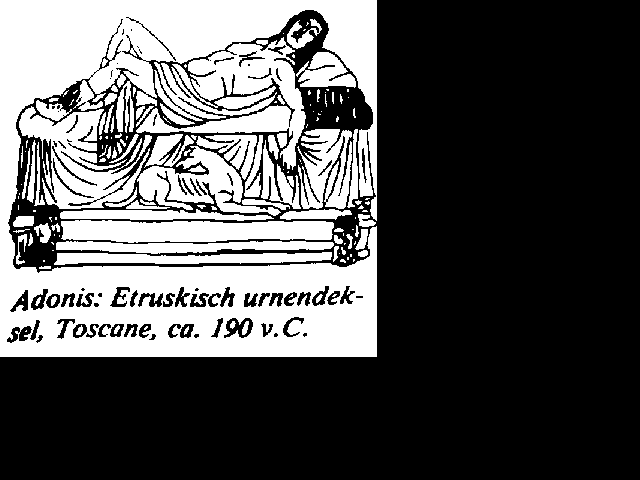
mythologische figuur uit de Oudheid, symbool van jeugdig-mannelijke schoonheid. Hij is van Syrisch-Fenicische oorsprong (Adon: `heer'), van het type `stervende en herrijzende goden', een demon van de zich jaarlijks vernieuwende groei. Als geliefde van Aphrodite (Lat. Venus) werd hij door een woedend zwijn gedood, volgens sommige overleveringen door de god Ares (Lat. Mars), die een dierengedaante had aangenomen. Uit het bloed van Adonis ontsproten anemonen of adonisroosjes, zijn ziel daalde af in de Hades. De godin van de liefde smeekte Zeus af dat Adonis slechts een deel van het jaar in de onderwereld hoefde te verblijven, en in de lente bij haar mocht terugkeren. Dat verzoek werd geeerbiedigd, en de opstanding van de jeugdige natuur werd met feesten, liederen en de aanleg van adonis tuintjes' gevierd. Adonis is de Griekse vorm van de Soemerische vegetatiegod Doemoezi (Aramees: Tammoez), de geliefde van godin Inanna. De jaarlijkse vegetatiecyclus werd in veel godsdiensten en culturen gesymboliseerd door in de onderwereld afdalende en periodiek daaruit verrijzende godheden.